
What Riley County Deed Records Document
Deed records in Riley County live with the Riley County Register of Deeds, the official custodian for recorded land instruments. The office sits at 110 Courthouse Plaza, second floor, Room B202, Manhattan, Kansas 66502, and answers the phone at 785-537-6340. Riley County deed records show which parties placed instruments in the public land record and the order in which each one was recorded.
| Instrument | What it generally does | Useful clue |
|---|---|---|
| Warranty deed | Conveys the grantor's interest with stated warranties | Grantor, grantee, legal description |
| Quitclaim deed | Conveys whatever interest the grantor may hold | Family, estate, or corrective transfer |
| Trustee or fiduciary deed | Records a transfer in a representative capacity | Trust, estate, or court context |
| Mortgage and release | Records security and later satisfaction | Lender, borrower, references |
| Easement | Records a right affecting land use | Benefited and burdened tracts |
| Plat | Depicts lots, blocks, streets, and dedications | Subdivision and plat reference |
A short index result never tells the whole story. The deed itself may carry reservations, exceptions, covenants, or cross-references that the index omits. Retrieve the instrument image and compare every legal-description reference before you rely on it.
Begin the Riley Chain With the Recorded Grantee
Start with the Riley County property search. That establishes the parcel ID, the legal description, and the apparent owner of record. Then search that owner as grantee; the acquisition deed names the transferring party and hands you the next name for a backward chain.
- Locate the newest plausible conveyance with the current owner as grantee.
- Compare its legal description with the parcel card and map.
- Record the grantor, deed type, recording date, and book/page or instrument reference.
- Search that grantor as an earlier grantee and repeat.
- When the electronic trail ends, continue in the corresponding deed book or microfilm index.
- Grantor
- The party transferring an interest.
- Grantee
- The party receiving an interest.
- Chain of title
- The linked sequence of instruments affecting the same land.
- Book/page
- A volume-and-page locator.
- Instrument number
- A unique recording reference.
The Riley County Grantor-Grantee Index Route
Riley County describes remote iDocMarket coverage reaching back to 1853. Remote use requires a subscription, while public terminals are available at the courthouse. The subscription interface varies, so do not assume a particular screen. Preserve both party-name spellings. Keep the recording date, document type, legal description, and recording reference as you go.
| Party name | Search grantor and grantee roles separately, including entities and variants. |
|---|---|
| Recording date | Shows office acceptance, not necessarily signing or closing. |
| Document type | Separates deeds from mortgages, releases, easements, plats, and liens. |
| Legal description | Confirms the same lot, subdivision, or rural tract. |
| Recording reference | Allows retrieval of the image or copy. |
Same-name matches are common in Riley County deed records. The owner of record on the tax roll may be an LLC, a trust, an estate, or an individual. It could be one of these forms. The legal description is the controlling cross-check. A parcel number helps discovery, but an older deed may not use the modern format.
Note: Friday courthouse doors are reported locked at noon even though office hours run to 5 p.m., so call before an afternoon visit. Call before an afternoon visit.
Riley Deed Records Reach Beyond the Screen
Riley County was organized in 1855. Surviving records include hand transcription beginning in 1857, computer images extending to June 1953, and a software transition in July 1985. The Register's broader coverage statement reaches 1853. So a missing remote result should prompt an access-channel check. It should not lead you to assume no deed exists.
Older material survives in paper and microfilm. The recorder FAQ says recorded material is scanned and digitally retained. It is also microfilm-copied for preservation in Hutchinson. That memorable salt-mine reference describes preservation, not a public portal. Before giving up, ask whether an instrument sits in paper or microfilm. It might also sit in the subscription collection or the courthouse terminal index.
MF588 Through MF591 Open the Historical Index
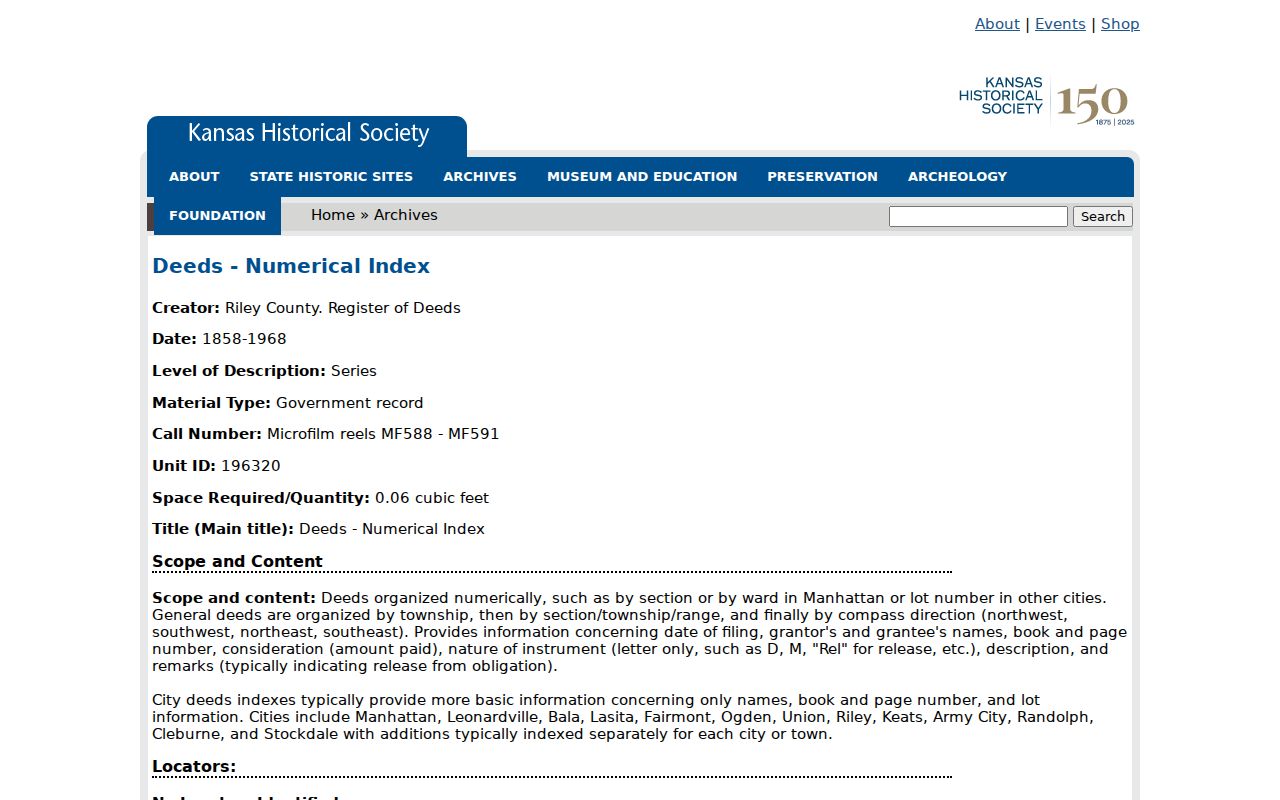
The Kansas Historical Society deed numerical index covers 1858 through 1968. It spans reels MF588 through MF591. Organization is by township, Manhattan ward, and city or town labels including Riley, Keats, Army City, Randolph, Cleburne, Stockdale, Bala, Lasita, Fairmont, and Union. Historic index geography does not always match a modern postal city.
The 1951 flood struck hard. So did the Tuttle Creek reservoir. Together they displaced Stockdale, Cleburne, and Garrison Crossing, and relocated Randolph. When an old deed names a vanished community, search the old town label, the section-township-range, creek or railroad references, and the plat before forcing the entry into a present street address.
The KSHS finding aid shows the reel-level route for older ownership research.
Plats and Federal Patents Supply Earlier Clues
A recorded plat explains the lot, block, street dedication, and book and page references. Later deeds build on those details. The Kansas Historical Society catalog identifies Riley County plat books from 1881 and 1909. The 1881 atlas also has a FamilySearch catalog entry.
A federal patent documents the initial transfer from the United States. It does not record the later county chain. The Ogden land office operated from 1857 to 1859. Use federal evidence for the first acquisition. Then rely on Riley County deed records for every transfer after that.
Easements and Releases Need Separate Checks
A chain built only from deeds is incomplete. Search mortgages and releases, easements, restrictions, tax liens, and relevant court material tied to the legal description. Some of that material needs separate checks. Not every easement gets recorded. A release should match the mortgage or lien it satisfies. UCC records, tax liens, mechanic's liens, judgments, and special assessments can sit with separate custodians.
District Court handles foreclosure, mechanic's liens, probate, quiet title, and related cases. Kansas Courts CaseSearch is a case-information window rather than a complete document repository. Courthouse terminals still matter.
Recorded does not mean clear title. The Register preserves and indexes instruments but cannot certify clear title or eliminate unrecorded interests.
Get a Riley County Deed Copy
You have several ways to get a deed copy. Retrieve available images through iDocMarket, use a public terminal, visit or telephone the Register, or request a copy by mail. The county's 2026 fee chart lists ordinary instrument copies at $1 per page, certification at $13, and research at $20 per hour, with separate plat, fax, mail, and UCC charges. Confirm current fees before ordering.
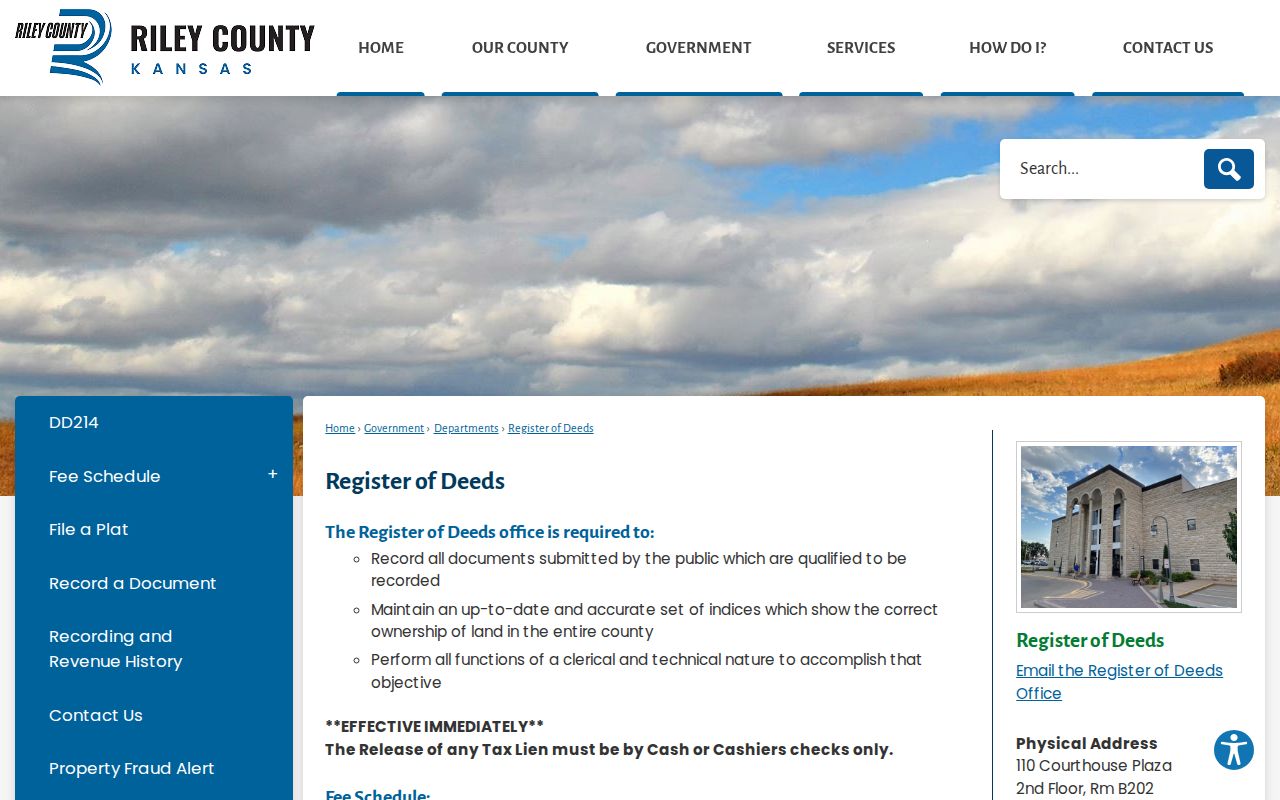
The official Register page provides contacts and remote-index access.
When you order, supply the party name, approximate recording date, instrument type, legal description, and any known reference. State plainly whether you need a plain or certified copy, and ask for the total. A focused KORA request may obtain an identifiable public record. It does not require the office to create a title report.
Probate and Court Orders Can Interrupt the Chain
Death alone never changes a deed index. Probate orders do. Fiduciary deeds, transfer-on-death instruments, trusts, divorce orders, and quiet-title judgments can each supply a missing link. Read the land record first. Let the court file add context when an instrument cites a case or fiduciary authority, then return to the recorder to confirm which order or deed was actually recorded.
Old newspapers and genealogy collections can explain family ties. They are clues, though, not conveyances. The legal description plus the recording reference keeps the chain tied to the correct parcel.
Probate and civil matters stay local. The Riley County District Court at 100 Courthouse Plaza hears them. Kansas CaseSearch can reveal a case number and party. Electronic access excludes some filings. It does not reproduce every courthouse document, so take the case number to a terminal or the clerk when an online summary hides the order a deed cites.
Estate transfers deserve extra care. The decedent, representative, trustee, heirs, and grantee often differ. Build a timeline of death, probate filing, order, execution, recording, and assessment update. That sequence explains why a parcel card can lag even when Riley County deed records are already current.
Reconcile every instrument to the same land. Compare subdivision, lot, block, section-township-range, acreage, and any reservations. Note both dates. Execution comes before recording, and that order can matter. If an instrument cites a prior deed, plat, easement, probate order, or mortgage release, retrieve that reference, because the index description rarely tells the whole story.
Bring all known spellings to the courthouse. Bring every capacity too, whether trustee, executor, administrator, or personal representative. Ask where the missing period sits: subscription index, public terminal, deed book, or microfilm. That channel-by-channel check beats repeating one online search, and it works especially well for Riley County deed records spanning the nineteenth and twentieth centuries.