
Fields in Riley County Property Tax Records
Two offices split the work behind these records. The Riley County Appraiser handles the appraisal and assessment side, while the Riley County Treasurer keeps the tax accounts and payment history. Each record shows only that office's piece.
| Field | What it shows | Official source |
|---|---|---|
| Appraised value | County estimate of full property value for the record year | Appraiser / Beacon |
| Classification | Property class used to select the statutory assessment rate | Appraiser |
| Assessed value | Appraised value multiplied by the class rate | Appraiser |
| Taxing unit and levy | Jurisdictions and mills applied to assessed value | Tax record |
| Special assessment | Separate charge for an eligible local improvement | Treasurer / city source |
| Bill and installments | Amount billed, due dates, status, interest | Treasurer |
Before comparing any figures, match the tax year and the parcel identifiers. Keep three numbers straight, too. A sale price is a transaction fact, the appraised value is the county's opinion, and neither equals the tax due.
Look Up a Riley Tax Account Step by Step
The Treasurer's search accepts owner name, Taxpayer ID, CAMA ID, or address. County instructions walk you through picking the account, then following the blue search and the green cart or VIEW path. These entry points give the cleanest lookup.
- Open the parcel first in Beacon and copy the owner display, address, and parcel identifiers.
- Open the official Treasurer search and payment site.
- Try CAMA or Taxpayer ID when available; otherwise search the exact address or owner.
- Compare the legal or parcel details, taxing unit, and year before opening the balance.
- Save the bill or receipt and call the Treasurer when a final payoff figure is needed.
Timing matters after you pay. Online payments post the next business day, and the displayed tax status can lag by as much as two business days. Interest keeps accruing under the law, so a screen balance is never a guaranteed payoff figure.
- Appraised value
- The estimated full value assigned by the Appraiser.
- Assessed value
- The taxable base after applying the statutory classification rate.
- Mill levy
- Tax per $1,000 of assessed value.
- Special assessment
- A separate charge tied to a local improvement.
- Tax lien
- A legal claim arising from unpaid tax, distinct from ordinary billing status.
Riley Property Classification Changes the Calculation
Kansas classification rates explain why appraised and assessed value differ so sharply in Riley County. The county's real-estate tax explanation sets residential property at 11.5 percent. Commercial and industrial sits at 25 percent, and agricultural land is 30 percent. Agricultural improvements carry 25 percent. Vacant lots plus qualifying nonprofit property land at 12 percent. Apply the right rate to the appraised value first. Then apply the mill levy to the assessed value.
The county's own example uses a 143.870 mill levy. Mills convert to dollars per thousand. Multiply assessed value by 143.870 and then by .001. The displayed intermediate formatting is not a separate tax. Special assessments and other account items can still shift the final bill.
Note: Pair the classification with the matching levy year, since mixing years produces a misleading estimate.
A Riley Valuation Notice Is Not the Tax Bill
A sample Riley County valuation notice lists a $633,600 appraised value and a $72,864 assessed value. It states plainly that it is not a tax bill. The notice carries the parcel and Quick Ref identifiers, taxing unit, legal description, class, and prior-year values. Those fields explain the assessment only. The Treasurer's later bill applies the final levies and account charges.
Valuation work runs on an annual cycle each May and June. The Appraiser reviews values then and hears informal appeals. That single cycle draws more than 700 informal hearings. Small-claims and Board of Tax Appeals routes sit beyond it. Those numbers show why valuation questions belong with the Appraiser, not payment staff.
Riley County Tax Dates and Payment Lag
The Riley County tax calendar moves in stages. Levies are finalized in early October. Statements go out in November. Real-estate installments are generally due December 20 and May 10. Missing a deadline adds interest and can push the account into delinquency, so confirm the dates on the county's current calendar since weekends, statute changes, and account circumstances all matter.
The county's Treasurer tax page documents the supported identifiers and payment route.
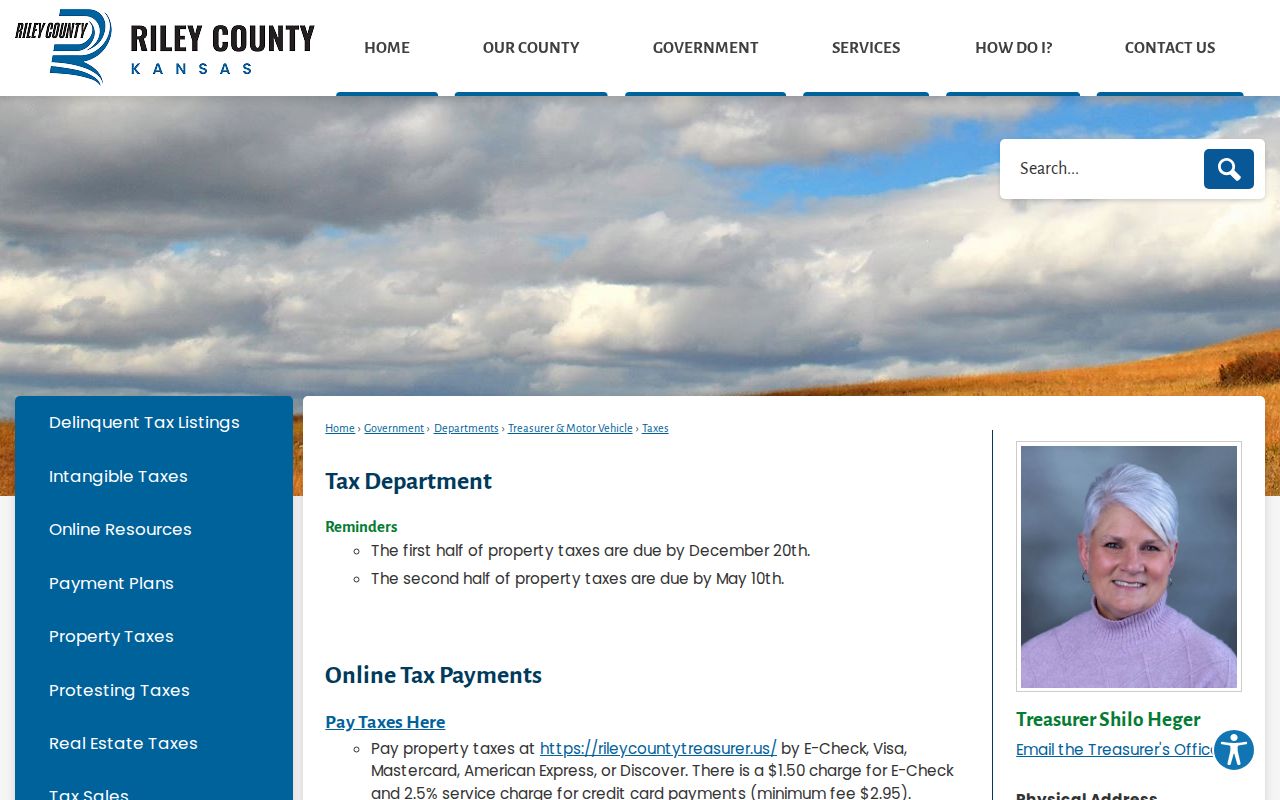
Convenience charges on cards and electronic checks are processing costs, not property tax. Check the fee disclosure at checkout before you confirm. If you just paid, keep the confirmation and allow the posted processing interval before assuming the account is still unpaid.
Appeal a Riley County Assessment, Not a Tax Rate
Disagreement over value starts with the Appraiser. The deadline is printed on the valuation notice itself. Bring the property record card. Add photographs, measurements, condition evidence, and comparable information available within the lawful window. Include any correction to classification or listed property facts. Request an informal review first. Keep the notice and the office's response for later steps.
Further review can move through Kansas small claims as applicable. It can also reach the Board of Tax Appeals. An appeal targets the appraisal, the classification, or the property facts on record. It cannot make the Appraiser change a mill levy. Nor can it erase a correctly calculated Treasurer balance.
Protect the deadline. Use the appeal date printed on the current Riley County valuation notice and contact the Appraiser promptly; do not rely on a prior year's calendar.
Public, Restricted, and Time-Limited Tax Data
Riley County treats ownership parcels and assessment information as public. Confidential commercial income data and certain sales material carry special limits. Comparable-sales reports stay public for 30 days after valuation notices go out. Beacon's December 2025 replacement brought clearer values, advanced search, printable property record cards, interactive GIS, and a tax-distribution chart. The Appraiser and Treasurer systems remain separate.
When online access fails, other routes work. Request a property record card directly. Call or visit the Appraiser, or ask the Treasurer for the bill. You can also file a focused Kansas Open Records Act request for an identifiable existing record. KORA does not override statutory confidentiality.
From Delinquency to Riley Tax Foreclosure
Riley County considers real estate eligible for foreclosure after three years of delinquency, subject to the governing process, notice, redemption rights, court action, and current sale terms. A delinquent account is not a completed transfer of ownership. Treat the Treasurer balance, the court case, the sale notice, the confirmation, and the recorded deed as separate events.
The official tax-foreclosure auction page states the buyer restrictions and due-diligence terms.
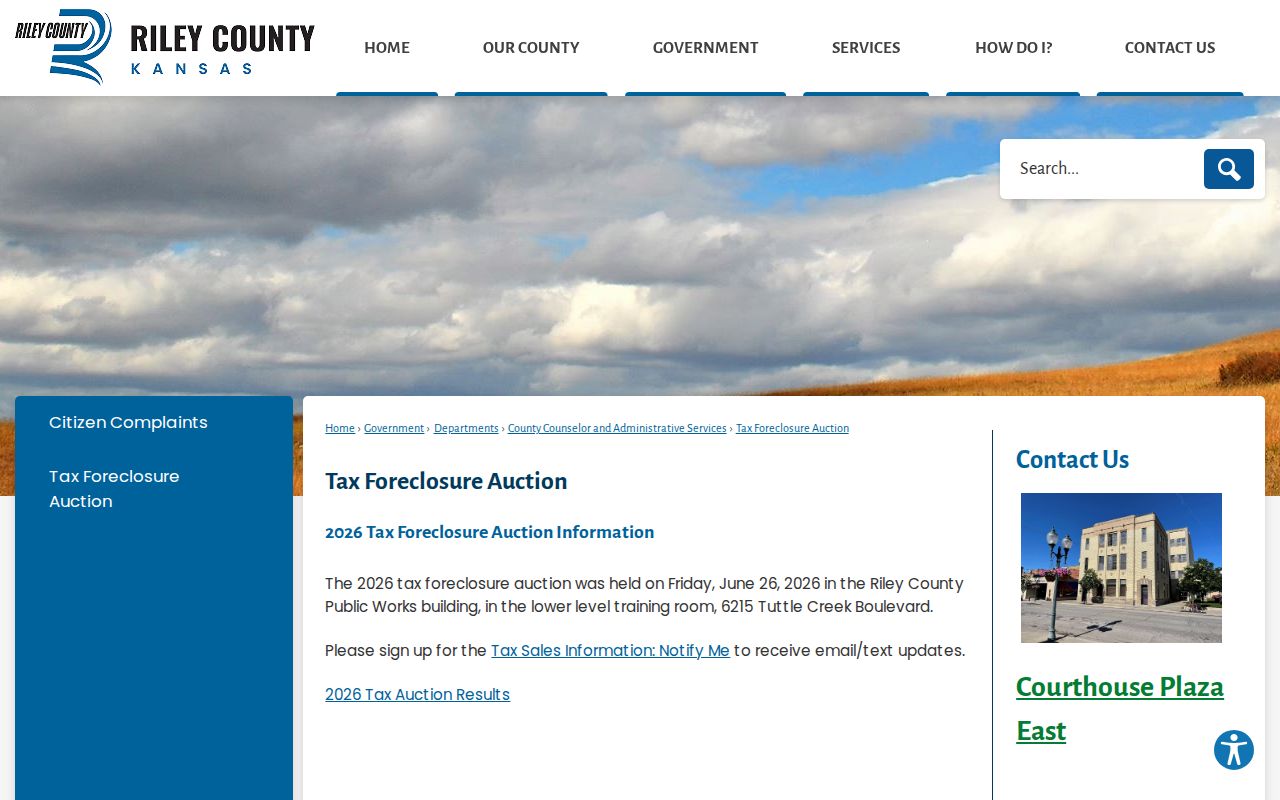
Winning at auction does not make you the owner. Court confirmation comes first. Until a Riley County judge confirms the sale, a bidder cannot take possession, change locks, collect rent, or otherwise act as owner. Treat the auction list as a lead only: confirm the legal description, access, taxes, court status, and the eventual deed, because easements, covenants, and restrictions may survive and parcels sell as is.
Special Assessments Require a Local Source Check
Sewer, water, and street projects can add special assessments on top of the ordinary ad valorem tax. These are not uniform. The county's tax explanation links city-specific assessment material, and project dates or payment terms vary by jurisdiction. Match each assessment description to the parcel number. Verify it with the office named on the record.
Before a purchase or appeal, pull four items together. You want the current property record card, the latest tax statement, any special-assessment schedule, and recorded or court liens. That set beats any single balance screen. It keeps valuation questions with the Appraiser, billing with the Treasurer, and title questions where they belong.
Read the details, not just the amount. The project name, authorizing jurisdiction, principal balance, installment period, and payoff instructions all matter, and none of them necessarily follow the ordinary tax calendar. A Manhattan improvement may carry a city record an unincorporated parcel never has. Ogden and Riley projects need those cities' own documents. The county account confirms what was billed.
Numbers sometimes disagree. Check the effective year first. The Appraiser's current value, a prior valuation notice, the November statement, a recent payment receipt, and an auction list can each describe a different stage of the same parcel. Keep copies of everything. Ask the Appraiser about parcel facts or value, the Treasurer about billing and payoff, the city about its improvement project, and the Register or District Court about a recorded or litigated lien.
This division of responsibility is what keeps a Riley County property tax search precise. It stops a special assessment, a delinquent status, or a foreclosure notice from being misread as proof that ownership already changed.