
Build Riley County's Owner Timeline
A backward chain works like a ledger. Begin with a deed known to be current. Each transfer becomes one row. The grantor on that deed should appear as the grantee on an earlier acquiring deed for the same legal description. Because dates and instrument types vary by parcel, treat the form as a work sheet, not as sample facts about one property.
| Transfer date | Grantor to grantee | Deed type | Book/page |
|---|---|---|---|
| Newest relevant record | Prior owner to current grantee | Record exact label | Capture citation |
| Next older record | Earlier owner to prior owner | Record exact label | Capture citation |
| Earlier book or film | Pre-index owner to later owner | Deed, patent, or court transfer | Capture reel and page |
Riley County land records reach back to 1853. Recent and current recordings sit with the Register of Deeds and iDocMarket. Older owners may require the courthouse's paper or microfilm holdings. The Kansas Historical Society's numerical index, a recorded plat, or federal tract-book and patent material can push the trail even deeper.
Riley County's Deed Time Depth
The Register of Deeds offers subscription access to land records reaching back to 1853. The oldest hand-transcribed material sits in September 1857, patent deeds included. Computer images begin in June 1953. Software tracking covers current recordings plus records back to July 1985. Those dates overlap on purpose. Each marks an access milestone rather than a single clean cutoff.
The Kansas Historical Society catalogs a separate Deeds Numerical Index for Riley County. It spans 1858 through 1968 on microfilm reels MF588 to MF591. Before giving up on a transfer, check the county system. The book/page image may instead live on film or through another index. A blank online result proves nothing about whether the deed exists.
Older chain route. Riley County's remote collection reaches back to 1853, but older owner work can still require courthouse books, microfilm, and archival finding aids.
See Riley County's Deed Index
The Kansas Historical Society finding aid identifies the numerical deed index, its date range, and its microfilm arrangement.
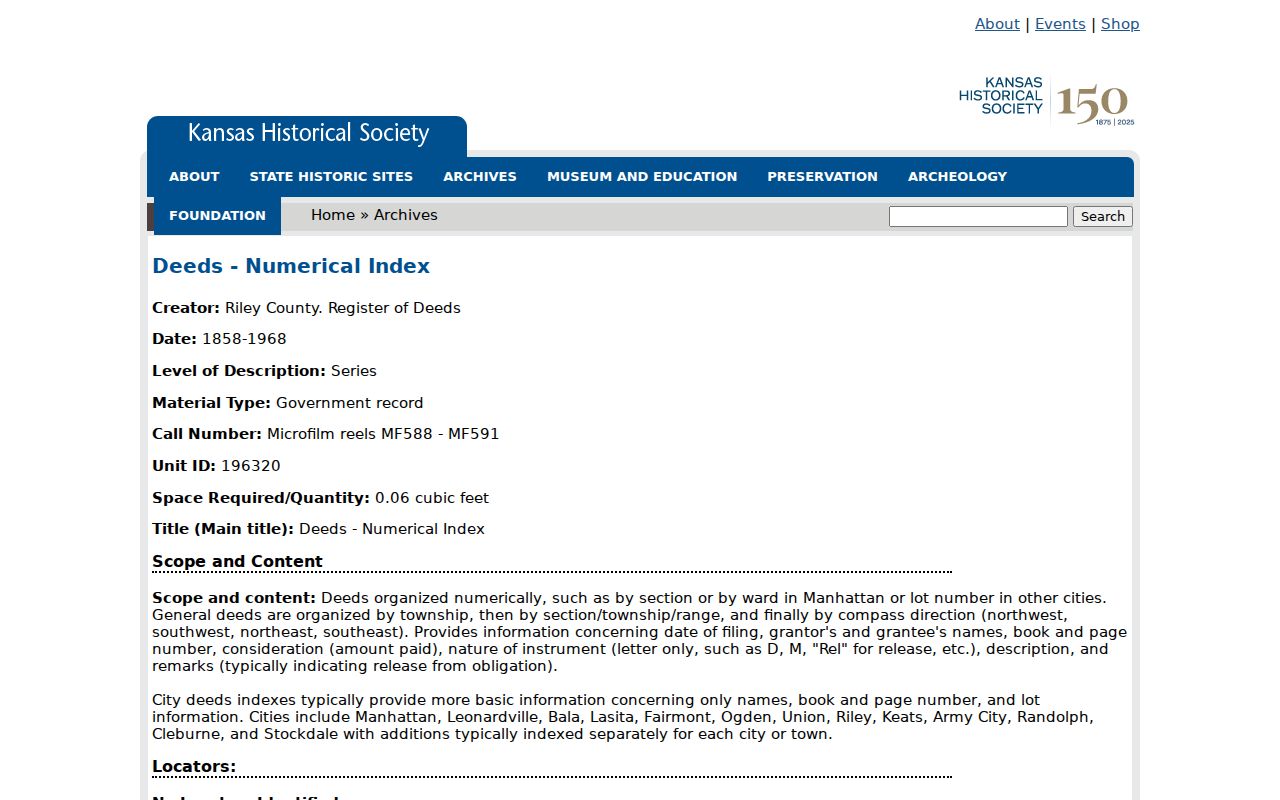
Older Riley County owners were indexed by township, Manhattan ward, or named city rather than by one countywide modern address. That is why the reel list matters.
Reverse Riley County's Deed Chain
Use the current owner only to find the starting deed. After that, the legal description and recorded citations control. The recorder's index can hold deeds, mortgages, releases, easements, tax liens, plats, and other instruments. Keep each true conveyance apart from events that merely burdened an interest. Also set apart events that released an interest.
- Match the present parcel and find the newest deed in which the current named party was grantee.
- Copy the grantor, grantee, date, instrument, book/page, and full legal description from that deed.
- Search the grantor as a grantee in an earlier period. Compare the land description before adding that deed to the timeline.
- Repeat until the online or current index stops, then move the same place and citation clues into deed books, microfilm, and plats.
- Grantor and grantee
- The party conveying an interest and the party receiving it.
- Chain of title
- The linked sequence of instruments affecting ownership of the same land.
- Reverse index
- An index arranged to find a party on the opposite side of a conveyance.
- Warranty deed
- A deed with title covenants stated by the grantor.
- Quitclaim deed
- A deed conveying whatever interest the grantor has without the same warranties.
Map Riley County's Former Owners
MF588 holds townships 6 and 7 through 1955. MF589 adds townships 8 and 9 through 1961. It also covers more of townships 10 and 11, and Manhattan wards 1 and 2. MF590 carries Manhattan wards 3 through 7 plus Leonardville, Bala, Lasita, Fairmont, and Ogden. MF591 rounds out the set with Union, Riley, Keats, Army City, Randolph, Cleburne, and Stockdale. Its coverage runs through 1968.
That geography can unlock a prior-owner search when today's city label fails. Index fields cover filing date, grantor, grantee, and book and page. They also include consideration, an instrument letter, description, and remarks. City entries run simpler. Expect names, book and page, and lot.
Riley County Places That Moved
The 1951 flood and the later Tuttle Creek reservoir project displaced Stockdale, Cleburne, Garrison Crossing, and Randolph before the reservoir's 1963 dedication. A historic deed may name a community that no modern street search can find. Don't substitute the nearest current address. Search the old town or index label instead. Then compare plat, railroad, creek, and adjoining owner clues. Section, township, and range numbers should line up too. The recorded deed chain and current GIS can bridge prior owners forward. Riley was once called Riley Center, and Ogden's older records may use original-townsite blocks.
Riley County Plats Name Owners
The Kansas Historical Society lists Riley County ownership maps from 1881 and 1909. FamilySearch catalogs the 1881 historical plat book as well. It notes map pages and an index. Viewing images may require a login or a center visit. Roads, rail lines, streams, and neighboring owners all appear on these plats. Former owner labels appear there too.
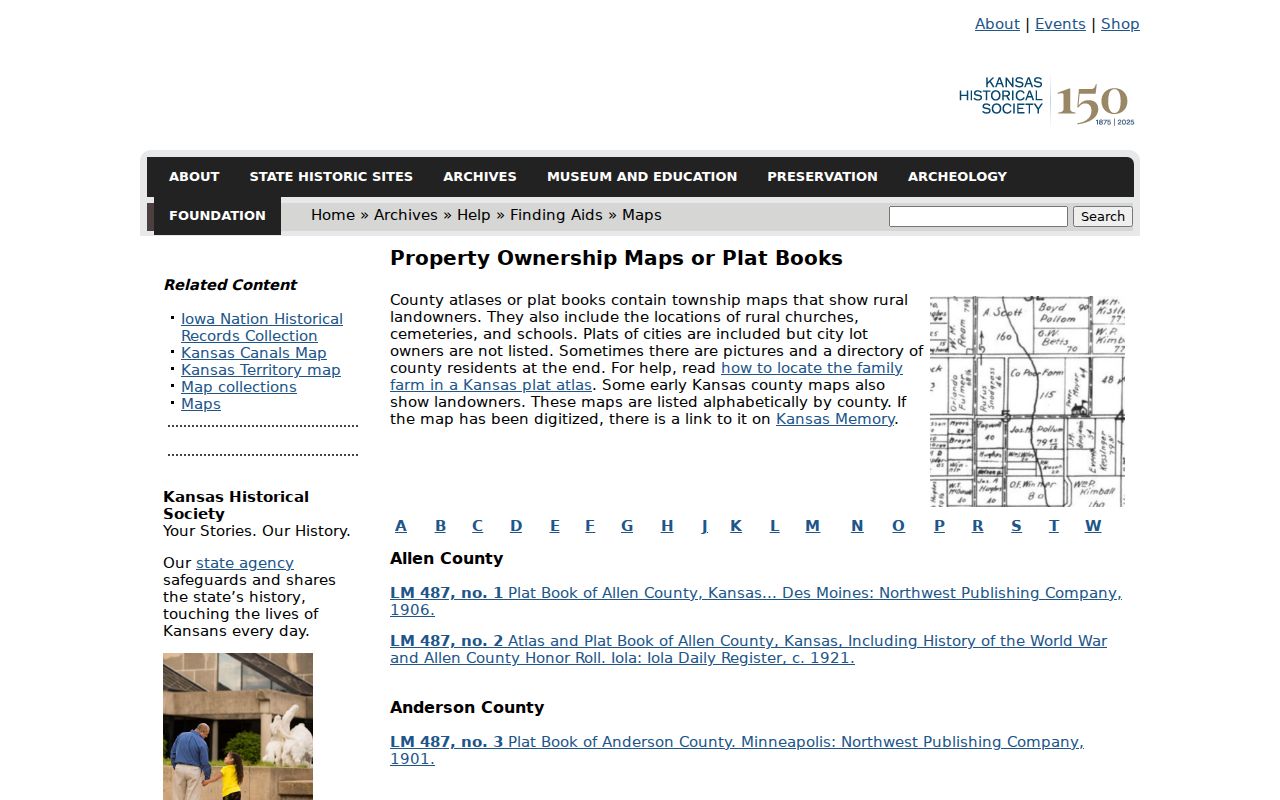
The official listing helps identify the atlas and call number. A printed owner label proves only its own era. Compare it with deed books before treating it as a conveyance.
Riley County Court Transfer Clues
A chain can jump because ownership passed through probate, divorce, foreclosure, quiet title, or guardianship. Riley County District Court holds these local matters. Kansas CaseSearch offers a party or case-number window. The online view is not the whole courthouse record.
Follow the court lane only when the deed or index points there. A death certificate alone proves no transfer. The court order and the recorded instrument must tie back to the same legal description. Mortgages, releases, and easements between deeds can also explain gaps without naming any new owner.
Riley County's Earliest Prior Owners
The very first owner often appears in federal land records rather than county files. Kansas tract books list the legal description and grantee. They also give acreage, price per acre, total amount, and the sale authority or date. They are not indexed by name. Search by land description first. Then tie the patent to the earliest Riley County deed. Ogden's federal land-office era, 1857 through 1859, sits at the start of that trail.
House-history sources fill in the human story. The Riley County Genealogical Society, historical newspapers, museum archives, and old directories can name past residents. They can add color. They yield clues, though, not conveyances. Sometimes you just need one recorded instrument or a certified copy. Take the Riley County deed records route instead of rebuilding the whole chain yourself.
Use the past with care. Former-owner research supports house history, estate work, and property diligence. Never use old or current owner data to track or harass anyone.
Local repositories can break open a stubborn link. The Kansas Historical Society's Riley County collection runs from 1856 through 1993. Its microfilm holds deeds, mortgages, and court files. It also holds estate and guardianship papers, divorce records, school-boundary material, and Manhattan government documents. The Riley County Historical Museum keeps an archive and library, open by appointment. Manhattan Public Library holds long newspaper runs. Sale notices, probate notices, street changes, and subdivision announcements all surface there.
The Riley County Genealogical Society search takes a surname, a first name, a record type, and a results-per-page setting. Its database is large. Its shift from a "Surname Search" label to "Records Search" helps when a name changed or was misspelled in the records. Treat every match as a clue pointing back to the deed. A directory entry, obituary, or newspaper item may show someone lived nearby. Only a recorded land instrument proves that person took or gave up the parcel interest, though.
At the recorder counter, cite the book and page. Or use a public terminal to dig deeper. Plain instrument copies cost $1 per page. Certification adds $13 per document. Staff offer basic lookup help, but they cannot certify a chain as clear title. That limit matters most when a prior owner search backs a purchase, an estate, or a dispute. It matters less for simple historical curiosity.